

The IRS does not view your tax debt as a personal crisis, but as a procedural task to be completed through automation and aggressive collection. While a notice of a bank levy or a high-stakes crypto audit can feel like a financial death sentence, the reality is that federal tax resolution services are not about pleading for mercy; they are about a strategic defense of your rights.
You shouldn’t have to face complex regulatory jargon or the threat of wage garnishments alone when the system is increasingly driven by AI-driven reviews and rigid protocols.
We understand the anxiety that comes with a mounting federal tax liability, especially when facing the 7% interest rates of 2026. This guide promises to reveal the definitive pathways to resolving your debt and securing your financial future through expert-led defense strategies.
We will examine the specific mechanics of the Fresh Start Program, including the $50,000 threshold for streamlined agreements, and provide a clear roadmap to achieving a significant reduction in what you owe while ensuring total compliance.
Key Takeaways
- Recognize the shift in 2026 IRS enforcement priorities toward digital assets and high-income earners to protect your assets proactively.
- Differentiate between the three essential pillars of tax relief: audit defense, immediate collection stays, and structured debt settlement.
- Evaluate the strategic advantages of federal tax resolution services when comparing the Offer in Compromise against modern Installment Agreement options.
- Clarify the distinct authorities of Enrolled Agents and Tax Attorneys to ensure you select the correct representative for your specific procedural needs.
- Gain a comprehensive roadmap for securing relief from both federal and state tax authorities to restore your financial standing and compliance.
Table of Contents

- Navigating the 2026 IRS Landscape: Why Federal Tax Resolution Services Are Essential
- The Mechanics of Resolution: From Audit Defense to Debt Settlement
- Strategic Pathways: Comparing Offer in Compromise and Installment Agreements
- Selecting Your Advocate: Enrolled Agents vs. Tax Attorneys vs. CPAs
- Nationwide Tax Relief Co: Your Shield Against Federal and State Authorities
Navigating the 2026 IRS Landscape: Why Federal Tax Resolution Services Are Essential
Federal tax resolution isn’t merely a series of phone calls or a simple request for leniency. It’s a sophisticated legal process of administrative advocacy. In this framework, a representative uses their deep knowledge of the Internal Revenue Code to challenge inaccuracies and negotiate favorable outcomes. For many taxpayers, the complexity of these procedures makes professional federal tax resolution services an essential component of their financial defense strategy.
This is especially true as the IRS adopts more aggressive enforcement postures.
The 2026 regulatory environment is defined by high-stakes scrutiny. The IRS has publicly identified high-income earners and digital asset transactions as its primary enforcement priorities. With AI-driven application reviews now standard, the agency can identify discrepancies in crypto reporting or business expenses with clinical precision. If you’re managing significant assets or complex income streams, you’re operating in a landscape where a single administrative oversight can trigger an exhaustive audit or immediate collection activities.
The Escalation of IRS Collection Actions
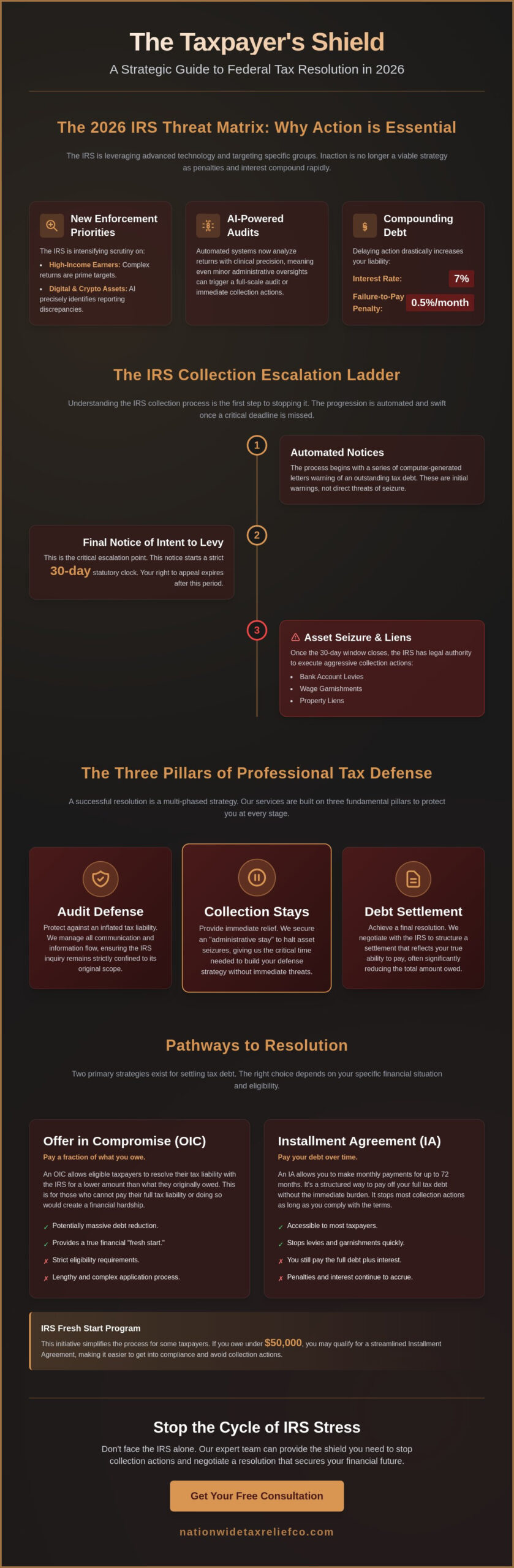
IRS collections follow a specific, tiered progression that moves from automated notices to active asset seizure. It’s vital to distinguish between a standard notice of deficiency and a Final Notice of Intent to Levy. While early notices are warnings, the Final Notice starts a strict 30-day statutory clock. Once this period expires, the IRS has the legal authority to seize bank accounts, garnish wages, and place liens on property.
In 2026, the cost of “doing nothing” has never been higher. With interest rates for underpayments reaching 7% in Q1 and Q3, and a failure-to-pay penalty of 0.5% per month, a static debt grows with alarming speed. Delaying action effectively compounds your liability every 30 days.
The Advantage of Professional Intervention
The most immediate benefit of hiring an expert is the establishment of a formidable shield between you and the government. Once a professional representative is retained, the IRS is generally prohibited from contacting you directly. This stops the cycle of stressful phone calls and high-pressure letters. Beyond the psychological relief, experts can secure an “administrative stay” on collection activities. This temporary freeze provides the necessary time to analyze your case and prepare a resolution strategy without the immediate threat of a levy.
In cases of extreme hardship or procedural errors, your advocate may also coordinate with the Taxpayer Advocate Service to ensure your rights are protected. Utilizing federal tax resolution services ensures that every communication with the IRS is disciplined, compliant, and focused on a specific outcome: the restoration of your financial freedom.
The Mechanics of Resolution: From Audit Defense to Debt Settlement
Effective resolution requires a transition from reactive fear to a disciplined, multi-phased defense strategy. Professional federal tax resolution services are structured around three fundamental pillars: audit defense, collection stays, and debt settlement. Each pillar addresses a specific stage of the IRS enforcement cycle. While an audit defense protects against the inflation of tax liability, a collection stay provides immediate relief by halting the seizure of assets.
Debt settlement serves as the final phase, where the total obligation is adjusted to reflect the taxpayer’s actual ability to pay.
For both IRS Personal Tax Audits and IRS Business Tax Audits, the primary objective is to manage the flow of information. Without representation, taxpayers often inadvertently provide documentation that expands the scope of the inquiry. A professional advocate ensures the examination remains focused on the specific line items identified in the initial notice.
This procedural boundary is critical for maintaining compliance while minimizing additional assessments. If you’re facing an audit, securing a representative who understands the nuances of administrative law is the most effective way to protect your interests. You can explore specialized defense options at nationwidetaxreliefco.com to begin stabilizing your case.
Specialized Defense: Crypto and Cannabis Tax Audits
The 2026 tax landscape presents unique challenges for emerging industries. IRS Crypto Tax Audits have become highly technical, as the agency now utilizes sophisticated blockchain analysis tools to track transactions across decentralized platforms. Precision in cost-basis reporting is no longer optional; it’s a requirement for avoiding fraud penalties. Similarly, IRS Marijuana (Cannabis) Tax Audits are complicated by Internal Revenue Code Section 280E. This provision prevents cannabis businesses from deducting standard business expenses, often leading to effective tax rates that exceed 70%.
Specialized representation is vital for navigating these industry-specific regulations and ensuring that every allowable deduction is meticulously documented.
Restoring Financial Freedom: Liens and Garnishments
When the IRS moves into active collection, the immediate priority is an IRS Wage Garnishment Release or a bank levy release. These actions are designed to restore your access to liquid capital and protect your current income. Securing a release typically requires demonstrating that the collection action creates an immediate economic hardship or by establishing a viable resolution plan. Once the immediate threat is neutralized, the focus shifts to an IRS Lien Settlement.
While a tax lien remains a matter of public record, a successful settlement or withdrawal can prevent the long-term erosion of your credit and financial reputation. In many cases, these efforts culminate in the IRS Offer in Compromise program, which allows qualifying taxpayers to settle their total debt for a fraction of what they owe. This methodical approach ensures that you move from a state of financial restriction to a clear path of recovery.
Strategic Pathways: Comparing Offer in Compromise and Installment Agreements
Choosing the correct resolution pathway is a calculation of your current liquidity and long-term compliance requirements. In 2026, the landscape for federal tax resolution services is defined by the continued evolution of the IRS Fresh Start Program. While the core objective remains providing relief to struggling taxpayers, the criteria for qualification have become more data-dependent. For instance, the threshold for a streamlined installment agreement remains at $50,000, allowing taxpayers to establish a repayment plan without the exhaustive financial disclosures typically required for larger balances.
Selecting the wrong pathway can lead to unnecessary financial strain, making a comparative analysis of settlement versus repayment essential.
One critical but often overlooked component of debt reduction is penalty abatement. The IRS may remove failure-to-pay or failure-to-file penalties if you can demonstrate reasonable cause, such as a natural disaster or serious illness. Given that interest rates have climbed to 7% in 2026, removing the underlying penalties can significantly lower the total accrual.
For those in extreme financial distress, the “Currently Not Collectible” (CNC) status offers a temporary reprieve. While the debt isn’t forgiven, the IRS ceases all collection activities until your financial situation improves, providing vital breathing room for recovery.
The Offer in Compromise (OIC) Framework
The Offer in Compromise (OIC) represents the most comprehensive form of debt relief. It’s a formal agreement to settle your liability for less than the full amount owed. The IRS evaluates these applications based on “Reasonable Collection Potential” (RCP). This formula accounts for the equity in your assets plus your projected future income over a specific period. To succeed, you must prove “Doubt as to Collectibility,” showing that the IRS likely won’t be able to collect the full balance before the statute of limitations expires.
This process requires a $205 application fee and meticulous documentation of all monthly expenses and asset valuations. For many, federal tax resolution services provide the technical expertise needed to navigate this high-rejection-rate program successfully.
Structured Repayment: Installment Agreements
If an OIC isn’t viable, structured repayment through an installment agreement is the standard alternative. There are several IRS payment options available depending on your total balance and monthly cash flow. A Streamlined Installment Agreement is often the most efficient path for debts under $50,000. For those who can’t pay the full amount even over time, a Partial Payment Installment Agreement (PPIA) allows for smaller payments until the collection statute expires.
Once an agreement is in place, the failure-to-pay penalty is reduced from 0.5% to 0.25% per month, slowing the growth of your balance. These agreements aren’t static; they can be modified if your income changes, ensuring your resolution plan remains sustainable.
Selecting Your Advocate: Enrolled Agents vs. Tax Attorneys vs. CPAs
Selecting an advocate is a decision of significant legal weight. Not every tax professional possesses the specific statutory authority required to represent you before the Internal Revenue Service. While many individuals rely on a local tax preparer for annual filings, resolving a multi-year debt or defending an audit requires a deeper level of procedural expertise. The most effective federal tax resolution services are typically led by professionals who hold one of three distinct designations: Enrolled Agent, Tax Attorney, or Certified Public Accountant (CPA).
Each role offers different advantages depending on the complexity of your financial distress.
A CPA is often the preferred choice for audit preparation and maintaining ongoing business compliance. They are state-licensed generalists who excel at forensic accounting and verifying the accuracy of financial statements. However, if your case involves potential litigation or criminal allegations, a Tax Attorney is indispensable. Their expertise lies in legal interpretation and the protection of attorney-client privilege, which is vital during high-stakes investigations.
For the vast majority of administrative resolutions, such as debt settlements and collection stays, the Enrolled Agent provides the most specialized technical focus.
The Power of the Enrolled Agent (EA)
Enrolled Agents are federally authorized practitioners who have earned the privilege of representing taxpayers before all administrative levels of the IRS. Unlike CPAs and attorneys, who are licensed by individual states, EAs receive their credentials directly from the U.S. Department of the Treasury. This gives them “unlimited representation rights,” meaning they can represent any taxpayer, regarding any tax matter, in any IRS office nationwide. Many elite EAs are former IRS agents who have transitioned into private practice.
These professionals bring an “insider” understanding of the Internal Revenue Manual (IRM), allowing them to anticipate the agency’s next move with clinical efficiency. Their practice is focused exclusively on technical tax law and procedural advocacy, making them formidable representatives in complex negotiations.
Vetting a Federal Tax Resolution Company
The 2026 IRS “Dirty Dozen” list specifically warns against “OIC mills.” These are aggressive marketing firms that overpromise results, often claiming they can settle any debt for “pennies on the dollar” before even reviewing a client’s financial data. You should prioritize firms that offer a transparent fee structure based on the actual complexity of your case rather than a percentage of the debt. A local presence in Los Angeles is also a significant advantage.
While federal issues are governed by national standards, a firm with regional expertise can seamlessly coordinate with California state agencies like the FTB or CDTFA. If you require immediate representation from seasoned professionals who prioritize procedural accuracy over marketing hype, contact our team at Nationwide Tax Relief Co to evaluate your case.
Nationwide Tax Relief Co: Your Shield Against Federal and State Authorities
Facing the Internal Revenue Service requires more than just technical knowledge; it requires a steady hand and a disciplined strategy. Nationwide Tax Relief Co serves as a formidable shield for individuals and businesses navigating high-stakes tax crises. While many firms focus solely on the numbers, we prioritize a methodical defense of your procedural rights. Our team acts as a specialized representative that understands the inner workings of bureaucratic systems, ensuring that every action taken is outcome-oriented and fully compliant with 2026 regulatory standards.
By providing federal tax resolution services that are both clinical in efficiency and optimistic in outlook, we guide our clients from a state of financial restriction to a clear path of recovery.
The complexity of tax debt is often compounded by the dual oversight of federal and state authorities. Resolving a liability with the IRS is a significant milestone, but it’s rarely the end of the process.
Our firm provides a comprehensive roadmap that accounts for every potential turn, ensuring that your financial future is secured against all regulatory bodies. We don’t just settle the immediate debt; we establish a foundation for long-term compliance and peace of mind.
A Comprehensive Approach to California Tax Matters
In the state of California, federal resolution often triggers subsequent inquiries from state agencies. If you secure an IRS Payroll Tax Settlement or a reduction in back taxes, the California Franchise Tax Board (FTB) is typically notified of the adjustment. This interplay requires a synchronized defense strategy. Nationwide Tax Relief Co possesses specific expertise in managing the nuances of California tax law. We provide aggressive representation for CDTFA sales tax disputes and EDD payroll tax audits, ensuring that a victory at the federal level isn’t undermined by state-level collections.
Our ability to handle both IRS and California authorities simultaneously provides our clients with a unified front against aggressive enforcement.
Getting Started: The Road to Resolution
The path to financial freedom begins with a professional consultation and an exhaustive case evaluation. We don’t rely on surface-level data; instead, we initiate a rigorous investigative phase. During this stage, our team uncovers your full IRS record, including transcripts and internal codes that the agency uses to track your liability. This deep-dive allows us to identify the exact levers available for your defense, whether that involves an IRS Lien Settlement or a complex audit defense.
Once we have a clear picture of the landscape, we implement a step-by-step resolution plan tailored to your specific financial circumstances. Don’t let the threat of asset seizure dictate your future. Secure your assets and stop the cycle of collection activities today by engaging our expert federal tax resolution services.
Securing Your Financial Recovery Through Strategic Advocacy
The 2026 tax landscape requires a shift from passive concern to active, administrative defense. The Internal Revenue Service increasingly relies on automated enforcement and high-stakes audits of digital assets and complex business structures. Achieving a sustainable resolution isn’t about simple negotiation. It’s about leveraging professional federal tax resolution services to protect your procedural rights and secure an immediate stay on collection activities like levies and garnishments.
This disciplined approach ensures that your response is as methodical as the agency’s inquiry.
Nationwide Tax Relief Co stands as your authoritative advocate in these critical moments. With deep roots in Los Angeles and a nationwide reach, our team provides specialized expertise in both IRS and California state tax matters, including the CDTFA, EDD, and FTB. We offer a clinical, outcome-oriented approach to complex challenges such as cannabis industry audits and crypto tax settlements.
Contact Nationwide Tax Relief Co for a Professional Consultation today to begin your transition from financial restriction to a state of verified compliance. Your path to a stabilized financial future is ready to be mapped.
Frequently Asked Questions
What is the “Fresh Start” program, and do I qualify in 2026?
The Fresh Start program is a collection of IRS policies designed to help taxpayers resolve debt through streamlined installment agreements, offers in compromise, and lien relief. In 2026, you generally qualify for a streamlined payment plan if your total debt is under $50,000. Qualification for a settlement depends on your “Reasonable Collection Potential,” which measures your assets and future income against the total debt. You must be current with all filing requirements to be eligible for any of these options.
Can federal tax resolution services actually stop a wage garnishment?
Professional federal tax resolution services can halt a wage garnishment by establishing an alternative resolution plan or proving immediate economic hardship. Once a representative is retained, they can negotiate a “stay” on collection activities while your case is being investigated. This process effectively restores your full take-home pay by replacing the aggressive levy with a structured agreement or Currently Not Collectible status. Taking action before the statutory 30-day notice period expires is the most effective way to prevent the garnishment from starting.
How much does it cost to hire a professional tax resolution firm?
The cost of professional representation is determined by the complexity of your tax history and the specific resolution pathway required. Factors such as the number of unfiled years, the presence of active levies, and the need for specialized audit defense influence the total fee. Most established firms utilize a transparent fee structure that reflects the technical labor involved in securing a settlement or release. It’s best to view this as a strategic investment to prevent the continued accrual of 7% interest and aggressive penalties.
How long does the IRS tax resolution process typically take?
The timeline for resolution varies significantly based on the program selected and current IRS processing speeds. A streamlined installment agreement can often be established within a few weeks. However, a complex Offer in Compromise or a specialized crypto audit defense may take six to twelve months to reach a final determination. Immediate actions, such as releasing a bank levy or wage garnishment, are typically prioritized and can often be handled within a few business days once representation is established.
What is the difference between an Enrolled Agent and a Tax Attorney?
Enrolled Agents are federally authorized practitioners who specialize exclusively in taxation and hold unlimited representation rights before the IRS. Tax Attorneys are legal professionals who focus on tax law and provide attorney-client privilege, which is essential for litigation or criminal matters. For most administrative resolutions, debt settlements, and audit defenses, an Enrolled Agent offers the most focused procedural expertise. Many taxpayers benefit from a firm that employs both designations to handle multi-faceted cases.
Can I settle my crypto tax debt with the IRS?
You can settle crypto-related liabilities through the same resolution pathways available for traditional currency debt, provided you are in full compliance with all filing requirements. The IRS treats digital assets as property, and settlements often involve an IRS Crypto Tax Settlement or an Offer in Compromise. Success in these cases requires precise blockchain forensic accounting to verify the correct cost-basis and total liability. Given the IRS’s 2026 focus on digital assets, having a representative who understands blockchain technology is critical.
What happens if I have unfiled tax returns for multiple years?
Having multiple years of unfiled returns makes you ineligible for most resolution programs until you achieve “compliant” status. The IRS generally requires the last six years of returns to be filed before they will consider a settlement or payment plan. If you don’t file, the IRS may file a Substitute for Return (SFR) on your behalf, which often leads to a higher tax bill because it doesn’t include your entitled deductions or credits.
Professional advocates can help you reconstruct missing records to file accurate returns.
Does the IRS negotiate on payroll tax debt for small businesses?
The IRS considers payroll tax debt a high-priority enforcement matter, but they do offer specific settlement options for small businesses. You may qualify for an IRS Payroll Tax Settlement or a structured payment plan to keep your business operational. Because payroll taxes involve funds withheld from employees, the IRS often pursues “Trust Fund Recovery Penalties” against business owners personally. Professional representation is critical in these cases to protect personal assets and negotiate a plan that the business can actually sustain.
Choosing the Right Federal Tax Resolution
The best federal tax resolution is the one that matches your actual finances. A federal tax resolution built on accurate income and expense figures, filed after you are fully compliant, is far more likely to be accepted and to hold up over time than a rushed request. Comparing the available options against your real ability to pay is the surest way to choose a federal tax resolution you can live with.
Federal Tax Resolution: Putting It All Together
A successful federal tax resolution follows a clear order. First, confirm the balance and file any missing returns, because federal tax resolution options are closed to taxpayers who are not compliant. Next, gather the financial records that support your case.
From there, the right federal tax resolution depends on your numbers. Steady income points toward an installment agreement, a low ability to pay points toward an Offer in Compromise, and genuine hardship points toward currently not collectible status.
Timing shapes every federal tax resolution as well. Acting before enforced collection begins preserves more options and lowers the total cost, while waiting narrows the paths available and lets penalties and interest keep building.
Finally, a durable federal tax resolution accounts for state exposure. For California taxpayers, aligning the federal plan with state agencies prevents a second problem from surfacing after the federal balance is resolved.
Why Professional Federal Tax Resolution Matters
Handling a federal tax resolution alone is possible, but professional guidance often changes the outcome. An experienced representative knows which federal tax resolution program fits your numbers, how to document the case, and how to communicate with the IRS.
Related guides: IRS Back Tax Resolution: A Strategic Guide to Settling Federal Debt and IRS Tax Debt Relief Guide: How to Lower What You Owe.
That expertise matters most when the balance is large or several years are involved. In those situations, a well-prepared federal tax resolution can mean the difference between an accepted agreement and a costly rejection, and between protecting your assets and losing them to collection.





3 Responses
It only works when I’m Finland.