

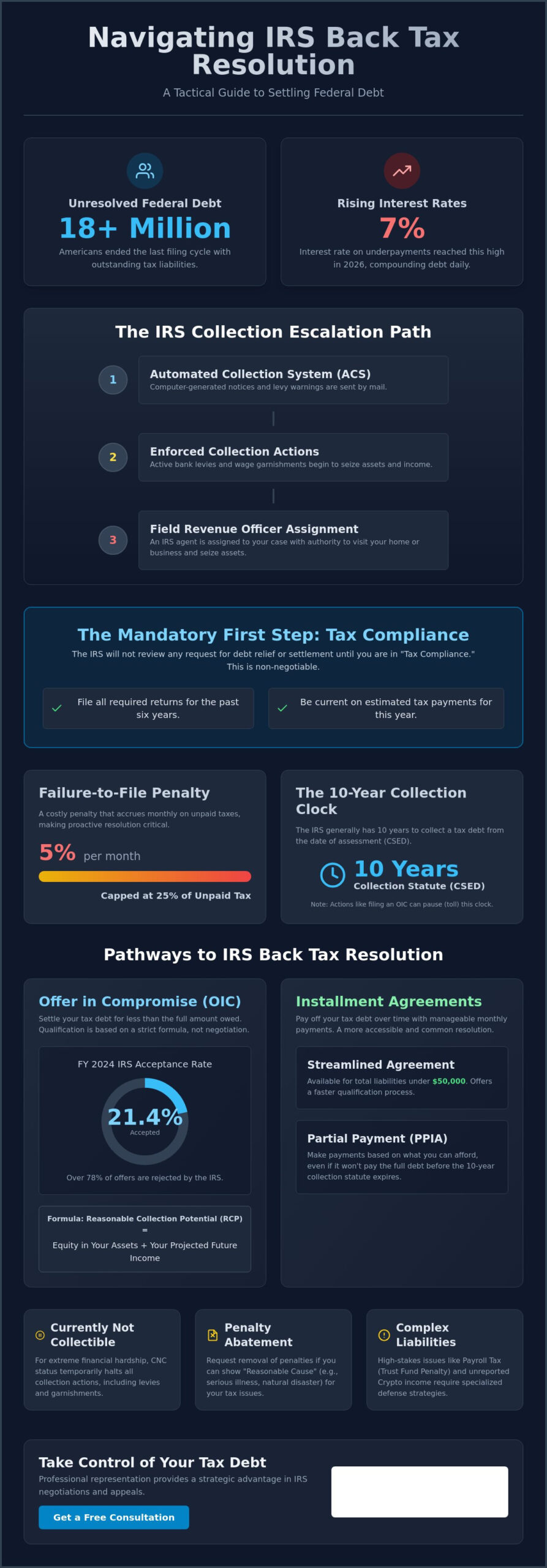
Did you know that over 18 million Americans ended the last filing cycle with unresolved federal debt, while interest rates on underpayments have reached 7% in 2026? When the IRS issues a notice of intent to levy or a Revenue Officer appears at your door, the situation often feels insurmountable. You aren’t just dealing with a bill; you’re facing a sophisticated collection machine that relies on your confusion to secure compliance.
Achieving a successful irs back tax resolution requires moving beyond simple filing and into a tactical defense of your financial rights.
It’s natural to feel paralyzed by the threat of bank levies, wage garnishments, and the dense jargon found in federal notices. You likely believe the IRS holds all the cards, but federal law provides specific protections for those who know how to use them. This guide provides a professional roadmap to help you settle federal debt through proven legal channels and collection defense strategies. We’ll detail the 2026 requirements for an Offer in Compromise, explain how to qualify for streamlined installment agreements under the $50,000 threshold, and outline the precise steps to secure a permanent release from IRS collections.
Key Takeaways
- Understand why achieving total “Tax Compliance” is the mandatory prerequisite before the IRS will review any request for debt relief or settlement.
- Evaluate the mechanics of an Offer in Compromise and discover why alternative programs are often more effective for achieving long-term irs back tax resolution.
- Identify the tactical maneuvers necessary to secure an immediate stay on bank levies and negotiate the release of active wage garnishments.
- Learn how to manage high-stakes liabilities including the Trust Fund Recovery Penalty for payroll taxes and the complexities of unreported cryptocurrency income.
- Recognize the strategic advantage of professional representation when navigating the IRS Appeals process or seeking an Audit Reconsideration for unfair assessments.
The Fundamentals of IRS Back Tax Resolution
Effective irs back tax resolution isn’t a single event or a simple application. It’s a rigorous legal and financial framework designed to bring a taxpayer into good standing with the federal government. Before exploring specific relief programs, it’s vital to understand What Are Back Taxes? and how they accrue through unpaid assessments or unfiled returns. The IRS views resolution as a progression. You move from a state of delinquency to one of structured compliance.
This journey begins with full financial disclosure, often through Form 433-A or 433-B, which serves as the blueprint for your defense strategy.
The IRS generally has a 10-year window to collect outstanding debt, known as the Collection Statute Expiration Date (CSED). This clock doesn’t always run linearly. Certain actions, like filing for an Offer in Compromise or an appeal, can toll or pause the statute. Understanding your specific CSED is critical. It determines whether the IRS is racing against time or if they have years to pursue your assets. We analyze these dates to identify when a debt might simply expire, providing a powerful leverage point in negotiations.
Why Ignoring Back Taxes Is a High-Risk Strategy
Tax debt isn’t static. It grows daily through compounding interest and penalties. For 2026, the failure-to-file penalty is 5% of the unpaid tax per month, capped at 25%. Initially, your case resides within the Automated Collection System (ACS), which generates computer-issued notices and levies. If the debt is significant or you remain unresponsive, the IRS escalates the matter to a field Revenue Officer. These individuals have the authority to visit your home or business, conduct interviews, and initiate asset seizures.
Proactive irs back tax resolution stops this escalation before it reaches your front door.
The Goal of Resolution: Compliance vs. Settlement
True resolution requires achieving Tax Compliance first. This means you’ve filed all required returns for the past six years and are current on your estimated tax payments for the current year. The IRS won’t consider a settlement if you’re currently generating new debt. Once compliant, the strategy shifts to either a payment plan or a settlement. A Partial Payment Installment Agreement allows you to pay what you can afford over time; an Offer in Compromise seeks to settle the total debt for a lesser amount based on your Reasonable Collection Potential.
Each path has distinct long-term implications for your financial standing and peace of mind.
Evaluating Settlement Options: Beyond the “Pennies on the Dollar” Myth
Many taxpayers are misled by aggressive advertisements promising to settle massive debts for nearly nothing. The reality of irs back tax resolution is governed by precise financial formulas rather than arbitrary negotiation. The IRS isn’t looking to be generous; they’re performing a cold assessment of what they can realistically collect before the statute of limitations expires. Understanding the Official IRS Settlement Options requires a clear-eyed look at your assets, monthly cash flow, and the specific legal programs available to those in debt.
If a full settlement isn’t mathematically viable, other defense strategies exist to protect your standard of living. A Partial Payment Installment Agreement (PPIA) allows you to make monthly payments based on your actual disposable income, even if those payments won’t cover the full balance before the collection window closes. For those facing extreme financial hardship, Currently Not Collectible (CNC) status can temporarily halt all collection activities, including levies and garnishments, until your financial situation improves.
Additionally, Penalty Abatement can be used to remove failure-to-pay or failure-to-file fees if you can demonstrate “Reasonable Cause,” such as a serious illness or natural disaster.
The Offer in Compromise (OIC) Framework
An Offer in Compromise is a formal contract between the taxpayer and the federal government. To qualify, you must prove that the amount you’re offering is the maximum the IRS can expect to collect. This calculation, known as Reasonable Collection Potential (RCP), includes the equity in your assets, such as real estate and retirement accounts, plus your projected future income. In Fiscal Year 2024, the IRS accepted only 21.4% of OIC applications.
Most rejections occur because the taxpayer failed to account for asset equity or used unallowable living expenses in their financial disclosure. If you’re unsure how your financial profile aligns with these strict standards, obtaining a professional evaluation of your IRS debt can prevent a costly and unsuccessful application.
Installment Agreements and Payment Plans
For many, a structured payment plan is the most reliable path to resolution. Taxpayers who owe $50,000 or less can often qualify for streamlined installment agreements without providing extensive financial documentation. We often recommend a Direct Debit Installment Agreement (DDIA), as it automates the process and can reduce the failure-to-pay penalty rate to 0.25% per month. Negotiating these terms requires balancing the IRS’s desire for a quick payout against your need for sustainable monthly cash flow.
We focus on securing terms that prevent future defaults, ensuring your irs back tax resolution remains permanent and your assets stay protected from future seizure.
Immediate Defense: Stopping Levies, Garnishments, and Liens
When the IRS moves from sending notices to active enforcement, the pressure is immediate and overwhelming. Asset seizure isn’t just a threat; it’s a procedural step the IRS takes when communication has broken down. Securing an immediate stay of execution on a bank levy or stopping a wage garnishment requires a specific technical response. While exploring IRS options for tax debt is a standard starting point, the enforcement stage requires a tactical defense to protect your liquidity and your livelihood.
If an IRS Revenue Officer has appeared at your door, the situation has escalated beyond automated systems, and you need a strategy that stops the seizure of your property.
A primary goal of irs back tax resolution during an enforcement crisis is to act as a shield between you and the government. Once you designate professional representation, the IRS must generally stop direct contact with you. This shift moves the high-pressure conversation from your home or workplace to a controlled professional environment. This protection is vital when dealing with field officers who are authorized to conduct interviews and identify assets for immediate seizure.
By establishing a formal defense, you gain the time necessary to evaluate your financial data and propose a resolution that the IRS will accept in place of aggressive collection actions.
The Levy Release Process
When a bank receives a levy notice, it’s required to freeze your funds immediately. However, the bank must hold those funds for 21 days before sending them to the IRS. This 21-day window is your only opportunity to secure a release. To force a release, you must demonstrate “Economic Hardship,” proving that the seizure prevents you from meeting basic living expenses or operating a business.
We coordinate directly with the IRS Centralized Lien Operation to provide the financial documentation required to stop the transfer of funds. Unlike a bank levy, a wage garnishment is continuous and will remain in place until the debt is satisfied or a formal release is negotiated through a payment plan or settlement.
Managing Federal Tax Liens
A federal tax lien is a public claim against your property that can devastate your credit and jeopardize professional licenses. It’s important to distinguish between a “Lien Release” and a “Lien Withdrawal.” A release occurs once the debt is paid, but the history of the lien remains on your record. A withdrawal is far superior, as it removes the public notice as if the lien never existed.
If you need to refinance a home to satisfy your debt, we can apply for “Lien Subordination,” which allows a lender’s loan to take priority over the IRS lien. For those selling specific assets, a “Certificate of Discharge” can remove the lien from that property alone, allowing the sale to proceed and the proceeds to be applied toward your irs back tax resolution.
Resolving Complex Liabilities: Payroll, Crypto, and Business Debt
Standard irs back tax resolution often focuses on personal income, but business-related liabilities represent a far more aggressive enforcement category. The IRS treats unpaid payroll taxes and unreported international or digital assets with heightened scrutiny because these areas often involve systemic non-compliance. These cases aren’t handled by automated systems alone; they often trigger specialized audits and the involvement of Revenue Officers who are trained to identify personal assets that can be used to satisfy business debts.
Understanding the nuances of these complex liabilities is the only way to prevent a business failure or personal financial ruin.
For individuals with international interests, the Report of Foreign Bank and Financial Accounts (FBAR) represents a significant compliance hurdle. Failing to disclose foreign accounts with an aggregate value exceeding $10,000 at any time during the year can result in civil penalties that often exceed the actual balance of the account. Similarly, cannabis-based businesses face unique challenges under Internal Revenue Code Section 280E, which disallows standard business deductions.
Resolving these debts requires a sophisticated understanding of how the IRS applies these specific codes during the settlement process. We focus on creating a defensive perimeter that protects your operations while addressing these high-stakes assessments.
Payroll Tax and Business Resolution
The IRS prioritizes payroll tax debt over almost any other type of liability. Because payroll taxes include money withheld from employee paychecks, the government views a failure to remit these funds as a fiduciary breach. Through the Trust Fund Recovery Penalty (TFRP), the IRS can hold “responsible persons” personally liable for the unpaid taxes, effectively piercing the corporate veil. Our defense strategy involves challenging the “willfulness” of the non-payment and negotiating business-specific payment plans.
These plans are designed to satisfy the government’s requirements without depleting the operating capital necessary to keep your business running.
Crypto and Unreported Income Defense
Digital assets are no longer a blind spot for federal authorities. The IRS uses data from exchanges to issue discrepancy notices, such as the CP2000, when reported figures don’t align with their records. If you’ve received a notice regarding unreported crypto income, voluntary disclosure is a critical mechanism for mitigating the risk of civil and criminal penalties. Unreported business income requires a forensic approach to reconstruction before resolution.
We assist clients in reconstructing these financial records to establish an accurate tax basis. This forensic work often reveals that the actual liability is significantly lower than the initial IRS estimate. If your business is facing a TFRP assessment or a digital asset audit, you need a specialized defense for complex tax liabilities to protect your personal and professional assets.
The Role of Professional Representation in Tax Controversy
Engaging in a direct dispute with the IRS puts unrepresented taxpayers at a significant disadvantage. While the government often suggests that individuals can achieve the same results on their own, this ignores the inherent power imbalance between a citizen and a trained Revenue Officer. Professional representation creates a “Shield” Effect. Once you appoint a representative through a Power of Attorney, the IRS is generally prohibited from contacting you directly.
This immediately lowers the emotional pressure and ensures that every communication is handled by a professional who understands the internal procedures of the Internal Revenue Manual. Specialized tax attorneys don’t just fill out forms; they identify procedural errors, such as missed notices or incorrect assessment dates, that can invalidate an IRS claim entirely.
A comprehensive irs back tax resolution strategy requires looking beyond the immediate debt to your long-term financial health. The IRS often makes mistakes in its initial assessments, particularly in business audits or crypto-related cases. Without a professional to audit the auditor, these errors become permanent liabilities. Representation ensures that your rights are protected during every interview and that the IRS adheres to the Taxpayer Bill of Rights.
This oversight is often the difference between a settlement that allows for a fresh start and one that leaves a taxpayer in a cycle of perpetual debt.
Appeals and Audit Reconsideration
If the initial collection or audit outcome is unfavorable, the resolution process doesn’t end. You have the legal right to challenge these decisions through the Independent Office of Appeals. This office is separate from the examination and collection divisions that issued the initial assessment. Navigating an appeal requires a strategic evidence file that addresses the specific legal grounds for your disagreement. Similarly, Audit Reconsideration is a powerful tool when you have “New Information” that wasn’t considered during the original audit.
This process can significantly reduce a tax debt by correcting errors in the original assessment, provided the evidence is presented within the strict procedural guidelines the IRS requires.
Selecting a Legitimate Resolution Firm
The market for tax debt help is unfortunately saturated with “OIC Mills” that promise unrealistic settlements for high upfront fees. These firms often lack the technical depth to handle complex controversies and typically disappear once a standard application is rejected. A professional defense firm focuses on a multi-year strategy that addresses the root cause of the debt while protecting assets in the short term. It’s essential to have a direct line to the professional handling your case rather than a sales representative.
Nationwide Tax Relief Co provides the specialized defense needed for high-stakes federal tax controversies. A professional irs back tax resolution plan isn’t a quick fix; it’s a tactical defense of your financial future that ensures you stay compliant and protected from future enforcement actions.
Securing Your Financial Future Through Strategic Defense
Resolving federal tax debt is a procedural battle that requires precision and a deep understanding of the Internal Revenue Manual. You’ve seen that achieving total tax compliance is the non-negotiable first step, and that settlement options like an Offer in Compromise depend entirely on your Reasonable Collection Potential rather than marketing myths. Whether you’re facing a personal bank levy or a complex business audit involving the Trust Fund Recovery Penalty, the goal remains the same: stop the seizure of your assets and establish a sustainable path forward.
Successful irs back tax resolution isn’t just about paying what you owe; it’s about protecting your rights against a collection machine that often overreaches.
We provide national representation for federal tax controversy, offering specialized defense for high-stakes crypto and cannabis audits. Our team possesses the technical expertise required for immediate bank levy and wage garnishment release, acting as a shield between you and IRS enforcement. Get a Professional Case Evaluation from Nationwide Tax Relief Co to regain control of your financial standing today. You don’t have to face the IRS alone; a structured, professional defense is within your reach.
Frequently Asked Questions
What is the best way to resolve IRS back taxes?
The most effective path to irs back tax resolution depends on your specific financial profile, but the process always begins with achieving total tax compliance. You must file all past-due returns from the last six years and remain current on your current-year estimated payments. Once you’re compliant, we evaluate whether a streamlined installment agreement, a settlement, or a hardship status provides the most tactical advantage for your long-term financial health.
Can I really settle my tax debt for less than I owe?
You can settle your debt for less through the Offer in Compromise (OIC) program if you prove you’re unable to pay the full amount. The IRS uses a strict formula to determine your Reasonable Collection Potential, which includes your asset equity and future income. Success rates are low, with the IRS accepting only 21.4% of applications in 2024, so your proposal must be backed by precise financial data and legal arguments.
How long does it take to get an IRS levy released?
A bank levy release must be secured within the 21-day window before the bank sends your funds to the IRS. Once we provide evidence of economic hardship or establish a formal resolution plan, the IRS can issue a release in as little as 24 to 48 hours. However, the complexity of your case and the responsiveness of the specific IRS office can influence the final processing time.
What happens if I have unfiled tax returns for several years?
The IRS will eventually file a Substitute for Return (SFR) on your behalf, which usually results in a much higher tax bill because it lacks credits and deductions. You’re legally ineligible for any settlement or payment plan until these returns are prepared and processed. Filing these returns yourself allows you to claim the correct expenses and is the mandatory first step to stopping automated collection enforcement.
Will the IRS take my house or car for back taxes?
The IRS has the authority to seize vehicles and real estate, but they typically prioritize liquid assets like bank accounts and wages. Primary residences are generally treated as a last resort and require judicial approval for seizure. However, if you have significant equity and remain uncooperative, a Revenue Officer can initiate the process to satisfy the debt through the sale of your property.
Can I qualify for penalty abatement if I have a history of compliance?
You may qualify for the First-Time Abate (FTA) waiver if you haven’t had any penalties for the three years prior to the tax year in question. This administrative relief allows the IRS to remove failure-to-file and failure-to-pay penalties regardless of your reason for the delinquency. If you don’t meet the FTA criteria, you must demonstrate “Reasonable Cause,” such as a serious illness or natural disaster, to have fees erased.
What is a Revenue Officer and why are they at my door?
A Revenue Officer is a civil enforcement employee who handles complex or high-dollar tax debts that haven’t been resolved through automated notices. They visit your home or business to conduct interviews, secure unfiled returns, and identify assets for potential seizure. Their appearance signals that your case has escalated to field enforcement, requiring an immediate and professional response to protect your assets.
How does an IRS tax lien affect my credit score in 2026?
While major credit bureaus don’t include tax liens on consumer credit reports, the lien remains a public record that lenders and employers can easily discover. In 2026, an active lien can still cause a loan denial or prevent you from obtaining professional licenses and security clearances. A lien withdrawal is the only way to remove the public notice entirely, which is far more beneficial than a simple lien release.
Choosing Your IRS Back Tax Resolution
The best IRS back tax resolution depends on your finances. An IRS back tax resolution built on accurate figures, filed after all returns are current, is far more likely to succeed than a rushed request.
Steady income points toward an installment agreement, a low ability to pay points toward an Offer in Compromise, and genuine hardship points toward currently not collectible status. Matching the IRS back tax resolution to your real numbers is what makes it hold up over time.
For many taxpayers, an IRS back tax resolution is the difference between years of collection pressure and a clear path forward. The right back tax resolution reduces stress, protects income, and turns an unpredictable balance into a manageable plan.