

A business tax debt is more than a line item on a balance sheet; it’s an immediate threat to your operational continuity and personal financial security. With the federal budget deficit projected at $1.9 trillion for 2026, enforcement is intensifying through tech-driven audits and sophisticated data analytics. Seeking back tax relief for businesses has moved from a simple clerical task to a critical strategic defense.
You’re likely concerned about the prospect of bank levies freezing your payroll funds or the looming personal liability that comes with corporate payroll taxes. These fears are grounded in reality, especially when you’re forced to navigate the complex, often conflicting demands of the IRS and various state tax agencies.
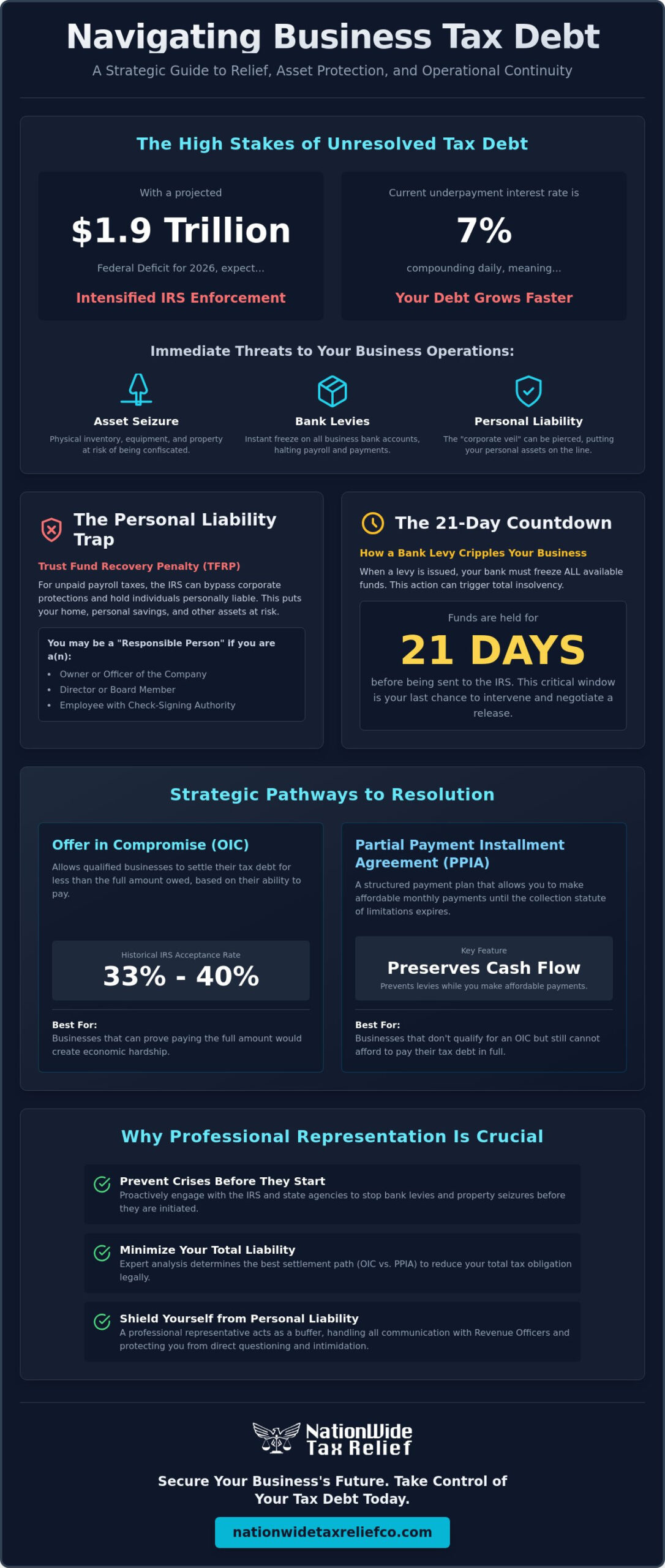
We understand that your primary objective is to resolve these liabilities without sacrificing your company’s future. This guide outlines the professional strategies and legal frameworks required to settle your debt while protecting your essential business assets. We’ll explore the current 2026 interest rates of 7% for underpayments and the specific criteria for programs like the Offer in Compromise, which historically maintains an acceptance rate between 33% and 40%.
By the end of this article, you’ll have a clear, methodical roadmap for removing tax liens, stopping levies, and returning your business to a state of permanent compliance.
Key Takeaways
- Learn how to secure back tax relief for businesses by utilizing strategic legal frameworks that prevent bank levies and protect operational cash flow.
- Identify the differences between an Offer in Compromise and Partial Payment Installment Agreements to determine which settlement path minimizes your total liability.
- Understand the critical 21-day window for bank levies and the mandatory legal steps tax authorities must follow before attempting to seize business property.
- Explore how to manage concurrent demands from the IRS and state agencies like the CDTFA or EDD through unified professional representation.
- Discover why professional counsel is essential when dealing with Revenue Officer visits to shield business owners from personal liability for corporate debts.
The Critical Stakes of Unresolved Business Back Taxes
Business tax liabilities are not merely administrative delays; they represent a fundamental threat to your entity’s existence. What are back taxes? In a commercial context, they’re the cumulative unpaid obligations resulting from income tax, payroll tax, and sales tax filings. While an individual might face limited wage garnishment, a business faces systemic dismantling. The IRS and state agencies possess the legal authority to execute bank levies, seize physical assets, and revoke the very licenses required to operate.
Securing back tax relief for businesses is a race against these high-pressure enforcement actions.
Unresolved debt also compromises your future growth. A federal tax lien is a public record that signals financial instability to every vendor, partner, and lender. It effectively freezes your ability to secure traditional financing or equipment leases. When your credit is compromised by a tax lien, the cost of capital skyrockets. This makes it difficult to maintain a competitive edge or fund the inventory needed for seasonal demands. Ignoring the problem doesn’t make it disappear; it only allows interest and penalties to compound daily.
Personal Liability and the Trust Fund Recovery Penalty
The IRS views payroll taxes as money held in trust for the government. Because of this, they utilize the Trust Fund Recovery Penalty (TFRP) to bypass corporate protections. If the IRS determines you’re a “responsible person”, which refers to someone with the authority to direct the payment of funds, they can hold you personally liable. This isn’t limited to owners. It can include officers, directors, or even employees with check-signing authority.
The corporate veil offers no protection against the TFRP. It effectively turns a business liability into a personal tax lien, putting your home, personal bank accounts, and private assets at risk.
The Impact on Business Operational Continuity
A bank levy is perhaps the most destructive tool in the government’s arsenal. When a levy is issued, your financial institution must freeze all available funds for a 21-day holding period. This doesn’t just stop profit; it halts payroll, vendor payments, and essential utility costs. For many companies, this 21-day window is the difference between survival and total insolvency. Without immediate intervention, the bank must send those funds to the IRS or state agency at the end of the period.
This often triggers a domino effect of bounced checks and broken contracts.
State agencies often act with even greater speed than federal authorities. Organizations like the California Department of Tax and Fee Administration (CDTFA) or the Employment Development Department (EDD) are known for aggressive collection tactics. They may seize physical inventory or revoke sales permits with very little notice. Seeking back tax relief for businesses requires a proactive approach to prevent these agencies from disrupting your daily workflow and damaging your B2B relationships.
Protecting your operations means addressing these liabilities before they reach the point of asset seizure.
Strategic Relief Programs for Federal and State Tax Debt
Resolving commercial tax debt requires a methodical analysis of available statutory programs. The IRS and state agencies provide specific pathways for back tax relief for businesses, yet each option carries rigid qualification standards that differ significantly from individual relief. While the strategic application of small business tax credits can mitigate current year obligations, resolving historical liabilities often necessitates a formal settlement or a structured payment plan designed to preserve operational liquidity.
An Offer in Compromise (OIC) remains the most sought-after resolution, allowing an entity to settle its debt for less than the full amount owed. In fiscal year 2024, the IRS accepted approximately 33% to 40% of proposed offers. This program isn’t a guaranteed right; it’s a legal settlement based on your “Reasonable Collection Potential.” For businesses that don’t qualify for a lump-sum settlement, a Partial Payment Installment Agreement (PPIA) offers a middle ground.
This allows you to pay an affordable monthly amount until the collection statute expires, even if it doesn’t cover the full balance. Additionally, penalty abatement is a vital tool. Since failure-to-file penalties can reach 25% of the unpaid tax, removing these charges significantly lowers the total burden.
State agencies like the Franchise Tax Board (FTB), CDTFA, or the EDD operate under different mandates than the IRS. California, for instance, offers settlement programs, but they often require proof that the business is truly insolvent or that the tax is legally in dispute. If you’re managing multiple agency demands, professional representation is often the only way to ensure these agreements don’t conflict with one another or drain your operating capital.
The Business Offer in Compromise (OIC) Framework
The IRS applies a “Doubt as to Collectibility” standard for business OICs. This means they’ll only accept an offer if they believe they can’t collect the full amount before the statute of limitations ends. They evaluate business assets, including accounts receivable, equipment, and future income potential. A common reason for rejection is the failure to account for “dissipated assets”-money or property spent on non-essential items after the tax debt was assessed.
Successful offers require a precise valuation of the company’s net equity in assets plus its monthly disposable income.
Installment Agreements and Payment Flexibility
Payment plans are categorized by the total debt amount. Businesses owing $50,000 or less in combined tax, penalties, and interest may qualify for a streamlined installment agreement, which requires less financial disclosure. If the debt exceeds $100,000, the IRS requires a full financial statement. Negotiating these terms is critical; you must ensure the monthly payment doesn’t prevent you from meeting
current tax deposits. In cases of extreme hardship, a business may be placed in “Currently Not Collectible” status, which temporarily halts collection actions while interest continues to accrue.
Defending Business Assets from Levies and Liens
Protecting your company’s physical and liquid assets requires a precise understanding of the legal timeline used by tax authorities. Before the IRS can seize property or freeze bank accounts, they must satisfy specific statutory requirements. This includes sending a “Final Notice of Intent to Levy and Notice of Your Right to a Hearing” at least 30 days before any enforcement action. This window is your most potent opportunity to secure back tax relief for businesses by requesting a Collection Due Process (CDP) hearing.
Filing for a CDP hearing legally halts most collection activities, providing the necessary time to propose alternative resolutions.
It’s vital to distinguish between a federal tax lien and a tax levy. A lien is a legal claim against your business property, including accounts receivable and future assets, to ensure the government is a priority creditor. It doesn’t take your money immediately, but it destroys your ability to sell property or secure new credit. A levy, however, is an actual seizure. It’s the point where the IRS or state agencies take funds directly from your bank or seize equipment to satisfy the debt.
Strategic defense focuses on preventing the transition from a lien to a levy through timely intervention.
Immediate Actions for Bank Levy Release
When a bank receives a levy notice, it’s legally required to freeze all available funds for a 21-day holding period. This period is the only window available to negotiate a release before the bank sends the money to the IRS. You must act within the first 48 hours to be effective. The most successful argument for a release is proving
“economic hardship.” If you can demonstrate that the levy prevents you from meeting payroll or paying essential vendor costs, the IRS may release the levy to keep the business operational.
Often, this release is granted in exchange for an immediate compliance plan or an installment agreement that addresses the underlying debt.
Navigating and Removing Federal Tax Liens
Resolving a tax lien requires more than just paying the balance. For businesses needing to refinance or secure a loan, lien subordination is often a viable path. Subordination doesn’t remove the lien, but it allows a specific lender to take priority over the IRS, which is often enough to satisfy bank requirements for new financing. Alternatively, a lien withdrawal completely removes the public record of the lien, provided the business meets specific payment criteria or enters a Direct Debit Installment Agreement.
Before any of these options are considered, you must file all unfiled tax returns. Compliance is always the prerequisite for back tax relief for businesses. State-level liens from the FTB or CDTFA can be even more restrictive, often attaching to business licenses and permits, which requires a separate, equally aggressive resolution strategy.
Professional Representation in Complex Tax Controversies
Engaging a tax representative provides a procedural shield between your operations and the aggressive enforcement tactics of the IRS. This buffer is essential for securing back tax relief for businesses, as it ensures that all communication follows strict legal protocols. A representative handles the scrutiny of government agents; they act as a protective barrier that allows you to focus on daily management without the constant pressure of direct interrogation.
Beyond communication, representation is vital for utilizing administrative remedies like Audit Reconsideration. This process allows a business to challenge an assessment if new documentation proves the original audit was inaccurate, potentially wiping out thousands in unfairly assessed debt.
Handling Revenue Officer Visits and Inquiries
When a Revenue Officer appears at your place of business, the situation is immediate and high-stakes. These are field agents with the authority to collect delinquent taxes and secure unfiled returns. You have the right to request that all inquiries be directed to your counsel rather than answering questions on the spot. Professional representation prevents “fishing expeditions” where agents might seek information beyond the scope of the current inquiry.
The protocol for providing records must be methodical. You should only provide the specific financial documents requested by law. Over-disclosing can inadvertently trigger secondary audits or lead to personal liability assessments. If an agent has arrived at your door, you should seek immediate representation to manage the interaction and protect your rights.
Audit Defense for Niche Sectors
Niche industries face unique regulatory hurdles that standard tax practices often overlook. For crypto-heavy businesses, the IRS is increasingly using data analytics and AI in 2026 to target unreported digital income and complex pass-through structures. Defending these entities requires a deep understanding of how the IRS tracks blockchain transactions. Similarly, the cannabis industry remains burdened by Section 280E; this prohibits traditional business expense deductions and creates an artificially high tax burden that requires specialized defense strategies.
State-level controversies are equally complex. The Employment Development Department (EDD) frequently targets businesses through payroll tax audits, specifically focusing on employee misclassification. Proving that your contractors are not employees is a data-heavy process that requires a robust defense of your operational structure. Whether dealing with federal or state agencies, filing multiple years of past-due returns is the first step to regaining standing and qualifying for back tax relief for businesses. Compliance is the only foundation upon which a successful settlement can be built.
Securing Your Future with Nationwide Tax Relief Co.
Securing back tax relief for businesses requires a partner capable of managing the intersection of federal and state tax laws. Nationwide Tax Relief Co. provides comprehensive representation for entities facing scrutiny from the IRS as well as state-specific agencies such as the California Department of Tax and Fee Administration (CDTFA), the Franchise Tax Board (FTB), and the Employment Development Department (EDD). We don’t just file paperwork; we build a strategic defense designed to halt aggressive collection actions and preserve your company’s equity.
Our team possesses deep expertise in negotiating high-stakes penalty abatements and debt settlements that reflect the true financial reality of your operations.
Our firm excels in defending businesses within high-pressure niche sectors. Whether your company is navigating the complex reporting requirements of the crypto industry or the unique tax burdens of the cannabis sector, we provide the specialized knowledge necessary to survive a rigorous audit. We understand that an audit isn’t merely a review of records; it’s a challenge to your business
model. If your operations are currently threatened by a bank levy or a wage garnishment, our immediate intervention protocols are designed to secure a release, restoring your access to payroll and vendor funds within the critical 21-day window.
Why Specialized Representation Matters
There’s a fundamental difference between a general CPA and a tax resolution specialist. While a CPA focuses on historical compliance and filing, a resolution specialist focuses on controversy and defense. We build customized strategies for your specific industry, ensuring that your defense accounts for the nuances of your business cycle. Our primary commitment is acting as a shield, protecting your personal assets from the reach of corporate liabilities and the Trust Fund Recovery Penalty.
We navigate the bureaucracy so you can return to running your business.
Taking the First Step Toward Resolution
The path to stability begins with a clear assessment of your total exposure. A confidential consultation allows us to review your current notices and identify the most effective administrative remedies available to you. To prepare for your initial case review, you should gather all recent correspondence from the IRS or state agencies, your most recently filed tax returns, and current bank statements. This data allows us to determine your “Reasonable Collection Potential” and move quickly toward a permanent resolution.
Contact Nationwide Tax Relief Co. today to protect your business operations.
Advancing Toward Permanent Tax Resolution and Asset Protection
Achieving back tax relief for businesses is a structured process that transforms a chaotic financial threat into a manageable compliance roadmap. By understanding the 21-day holding period for bank levies and the personal risks associated with the Trust Fund Recovery Penalty, you’ve taken the first step toward reclaiming control of your company’s future. Whether you’re navigating an Offer in Compromise or seeking to subordinate a federal tax lien for a critical business loan, the strategy must be precise and professionally executed.
Nationwide Tax Relief Co. stands as a shield between your operations and aggressive tax enforcement. We provide national IRS and state audit representation with specialized defense for high-stakes crypto and cannabis sectors. Our team offers extensive expertise in bank levy and wage garnishment release, ensuring your payroll and vendor funds remain protected. You don’t have to face Revenue Officers or complex state audits alone.
Get a Free Consultation with a Business Tax Specialist today to secure your assets and restore your operational continuity. Your business deserves a future free from the weight of tax debt.
Frequently Asked Questions
Can the IRS seize my business bank account without notice?
The IRS cannot seize your account without prior notification. They must issue a Final Notice of Intent to Levy and Notice of Your Right to a Hearing at least 30 days before seizing assets. Once a bank receives the levy, a 21-day holding period applies. This window is your final opportunity to intervene and secure back tax relief for businesses by proving economic hardship or proposing a compliance plan.
Am I personally liable for my company’s unpaid payroll taxes?
You can be held personally liable through the Trust Fund Recovery Penalty. This IRS tool allows agents to look past the corporate veil if you’re deemed a “responsible person” who willfully failed to pay payroll taxes. This liability attaches to your personal assets, including your home and private bank accounts. It’s one of the most aggressive enforcement actions used against business owners who fail to meet trust fund obligations.
How many years of back taxes can the IRS actually collect from a business?
The IRS generally has 10 years to collect unpaid taxes from the date they were assessed. This is known as the Collection Statute Expiration Date. However, this period can be extended if you enter into certain agreements or if you have unfiled tax returns. If a return was never filed, the statute of limitations for both assessment and collection never begins to run, leaving the business exposed indefinitely.
What is the difference between a tax lien and a tax levy for a business?
A tax lien is a legal claim against your property, while a tax levy is the actual seizure of that property. The lien acts as a public notice to creditors that the government has a right to your business assets, which often freezes your ability to secure financing. The levy is the physical or electronic taking of funds from bank accounts or the seizure of equipment to satisfy the debt.
Can I still get a business loan if I have an outstanding federal tax lien?
Securing a loan with an active tax lien is challenging but achievable through a process called lien subordination. This legal agreement allows a private lender to take a higher priority position than the IRS on specific collateral. Many lenders require this before approving a line of credit or equipment lease. It’s a strategic tool used to maintain operational cash flow while resolving back tax relief for businesses.
What should I do if an IRS Revenue Officer shows up at my business door?
You should request the officer’s credentials and immediately direct them to your tax representative. You aren’t required to provide an on-the-spot interview or immediate access to your financial records. Providing too much information during an unannounced visit can lead to expanded audits or personal liability assessments. Simply state that your counsel will handle all future inquiries and provide the necessary documentation through formal channels.
Is it possible to settle business tax debt for less than the full amount?
Settling for less than the full balance is possible through the Offer in Compromise program. The IRS accepts between 33% and 40% of these offers annually, provided the business proves it cannot pay the full amount before the 10-year statute expires. They’ll evaluate your “Reasonable Collection Potential” by looking at your assets and future income potential. This is a complex legal settlement that requires precise and technical financial disclosure.
How does a penalty abatement work for late business tax filings?
Penalty abatement removes the “failure to file” or “failure to pay” charges if you can demonstrate reasonable cause. This might include natural disasters, serious illness, or unavoidable business disruptions. For businesses with a clean three-year history, a First-Time Abate may be available. Removing these penalties can significantly reduce the total liability, as compounded interest and penalties often account for a large portion of the total balance due.
Business Back Tax Relief: Choosing the Right Path
Effective business back tax relief depends on the type of tax owed and the health of the company. A business back tax relief plan for income tax differs from one addressing payroll or trust-fund taxes, where personal liability for owners is a serious risk.
The strongest business back tax relief keeps the company operating while resolving the debt, using installment agreements, offers in compromise, or penalty relief matched to the business’s actual cash flow. Filing all required returns first is essential, because business back tax relief options are closed until the company is compliant.
Trust-fund payroll taxes deserve special attention. Because the IRS can pursue responsible individuals personally, a business back tax relief strategy that addresses this exposure early protects both the company and its owners from the most damaging outcomes.