

A final tax assessment from the IRS or a state agency like the FTB isn’t the dead end it appears to be. You likely feel trapped by a massive bill resulting from a missed audit appointment or an inaccurate Substitute for Return filing. Watching helplessly as the threat of bank levies and wage garnishments grows is an exhausting, high-pressure experience. It’s natural to assume that once the 90-day window to petition the Tax Court has closed, your options have vanished.
For related guidance, see our overview of the IRS audit reconsideration process and how to appeal an IRS audit, and review the official IRS audit reconsideration guidance for the current requirements.
We understand the weight of this burden, but there’s a structured path back to financial stability. By leveraging professional audit reconsideration services, you can effectively reopen a closed case and force a re-evaluation based on new evidence. This article provides a strategic roadmap for navigating technical protocols to stop collection actions and eliminate incorrectly assessed taxes, interest, and penalties. We’ll examine the specific requirements for IRS, EDD, and FTB reconsiderations to ensure your second chance results in a favorable, permanent resolution.
Key Takeaways
- Understand the technical distinction between a pre-assessment appeal and the post-assessment audit reconsideration process defined in the Internal Revenue Manual.
- Identify if you meet the specific eligibility criteria, such as having new documentation or having missed your original audit appointment due to a change of address.
- Learn the systematic approach to gathering and organizing evidence that the taxing authority hasn’t yet reviewed to successfully reopen a closed case.
- Discover the unique procedural requirements for disputing final assessments with California state agencies, including the CDTFA, EDD, and FTB.
- Recognize why professional audit reconsideration services are essential for navigating complex tax controversy protocols and stopping aggressive collection actions.
Table of Contents

- What is Audit Reconsideration? Your Technical Path to Disputing Tax Debt
- The Step-by-Step Process of Reopening a Closed Tax Audit
- Navigating State-Specific Reconsiderations: CDTFA, EDD, and FTB
- Strategic Representation: Why Professional Services are Critical for Success
- Secure Your Financial Second Chance Today
What is Audit Reconsideration? Your Technical Path to Disputing Tax Debt
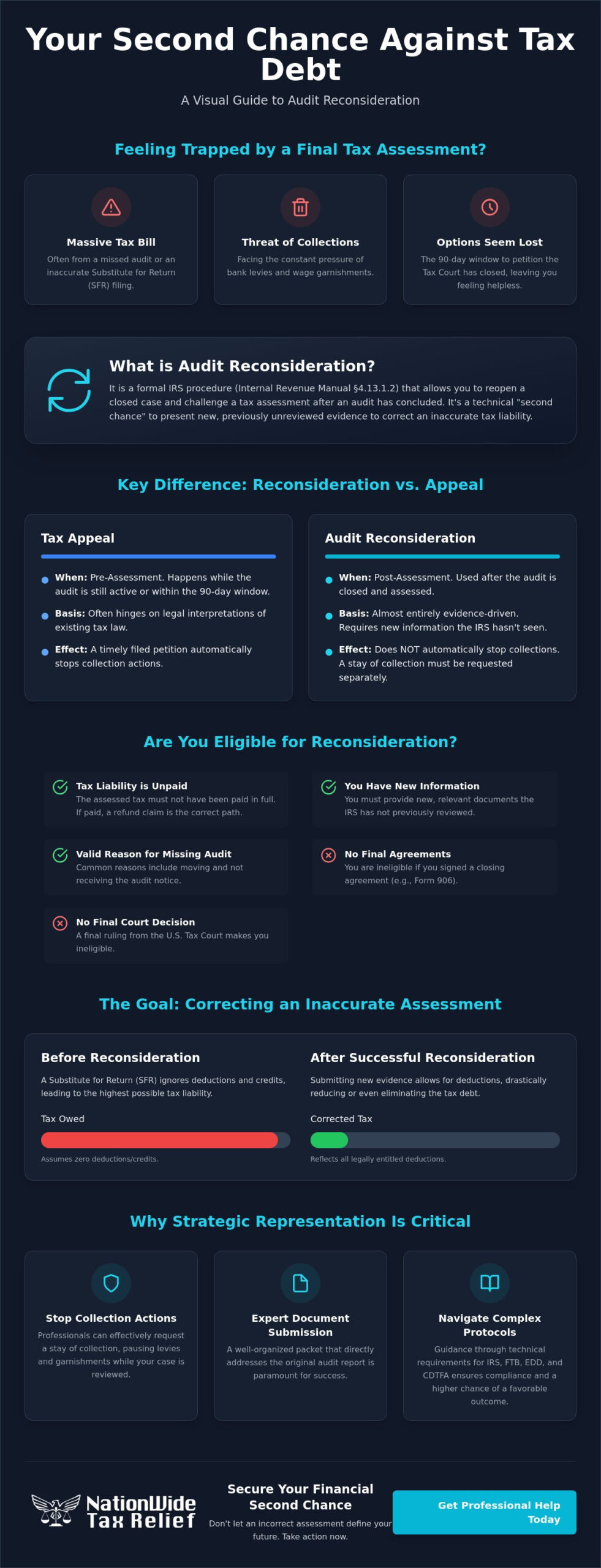
Audit reconsideration is a formal procedure that allows taxpayers to challenge an assessment after an audit has concluded. According to Internal Revenue Manual (IRM) §4.13.1.2, this process occurs when a taxpayer disagrees with the results of an income tax audit that has already been assessed and remains unpaid. It serves as a vital safeguard for those who missed their initial opportunity to contest the findings.
If you didn’t receive the original notice or failed to respond to a 30-day or 90-day letter, this is your primary mechanism for relief. Professional audit reconsideration services focus on presenting the specific documentation that was previously missing to reverse unfair tax liabilities.
The process functions as a technical “second chance” for taxpayers who found themselves on the receiving end of a default assessment. This often happens when the IRS conducts a correspondence audit and the taxpayer never receives the mail, perhaps due to a recent move. It also applies when the IRS files a Substitute for Return (SFR) on your behalf, which typically results in the highest possible tax liability because it ignores deductions and credits you’re legally entitled to claim.
By reopening the case, you’re asking the IRS to look at the facts again.
Audit Reconsideration vs. Tax Appeals: Key Differences
Understanding the timeline is essential for a successful resolution. A tax appeal is a pre-assessment action. It takes place while the audit is still active or within the specific window after receiving a Statutory Notice of Deficiency. In contrast, reconsideration happens post-assessment. While appeals often hinge on legal interpretations of tax law, reconsideration is almost entirely evidence-driven. You must provide specific, new information that the IRS hasn’t considered yet.
It’s also important to recognize that requesting reconsideration doesn’t automatically stop IRS collection activities. Unlike a timely filed Tax Court petition, the IRS can continue with levies or liens while they review your request. This is why audit reconsideration services are often paired with requests for a stay of collection. The goal is to pause aggressive enforcement while the merits of the new evidence are evaluated by an examiner.
The Statutory Authority Behind the Process
The foundation for this relief rests on Internal Revenue Code § 6404(a). This statute allows the IRS to abate the unpaid portion of any assessment that is excessive in amount, assessed after the statute of limitations has expired, or erroneously assessed. The IRS uses its discretionary authority to “rework” unresolved issues to ensure the final tax bill is accurate and legally sound. For many, audit reconsideration is a discretionary administrative process used to correct assessments that are excessive, erroneous, or illegal.
The IRS isn’t required to grant every request. They only do so when they believe the new information will result in a change to the tax liability. This makes the quality of the submission paramount. A well-organized packet that directly addresses the items contested in the original audit report is the only way to move the needle. When the agency sees clear, undeniable proof of an error, they’re generally willing to adjust the account to reflect the truth.
The IRS doesn’t grant every request to reopen a case. Success depends on meeting specific eligibility requirements that prove the current assessment is inaccurate. The most fundamental rule is that the tax liability must remain unpaid. If you’ve already paid the balance in full, you must typically file a formal claim for a refund rather than seeking reconsideration. Specialized audit
reconsideration services help taxpayers determine if their case meets the four primary conditions required for acceptance. Meeting the necessary criteria requires providing documentation the agency hasn’t seen before.
The IRS will generally consider your request if you disagree with their findings and have a valid reason for not providing information during the initial exam. However, they’ll categorically deny your request if you’ve already signed a closing agreement, such as Form 906, or if a final decision has been rendered by the U.S. Tax Court. The process is designed to correct administrative or evidentiary gaps, not to relitigate issues that have already been legally finalized.
Common Scenarios for a Successful Request
Many taxpayers find themselves eligible because of simple logistical failures. If you moved house and didn’t receive the original notice, the IRS likely moved forward with a default assessment. Since you never had the chance to present your records, the IRS audit reconsideration process is the appropriate channel to fix the error. Other common scenarios include missing an audit appointment due to circumstances beyond your control or discovering new receipts and records that were physically unavailable during the first examination.
If you’re facing these hurdles, consulting with IRS personal audit representation experts can help you package your evidence correctly.
The Substitute for Return (SFR) Exception
One of the most frequent uses of this process involves the Substitute for Return. When you don’t file a tax return, the IRS may eventually file one for you based on reported income from third parties. These assessments are notoriously high because the IRS assumes a single filing status with zero deductions. To resolve this, you must first prepare and file a complete, accurate original return for the year in question.
The IRS then uses the audit reconsideration framework to evaluate your filed return against their SFR assessment. This often results in a significant reduction of the tax, interest, and penalties originally charged to your account.
The Step-by-Step Process of Reopening a Closed Tax Audit
Initiating a formal dispute requires a methodical approach to identifying errors in the original examination report. You must first pinpoint the specific items, such as disallowed deductions, credits, or income figures, that the IRS adjusted. Once these are identified, the focus shifts to gathering information that the agency hasn’t yet considered. Utilizing professional audit reconsideration services ensures that your submission is structured to meet the high evidentiary standards required by the Internal Revenue Manual.
The goal is to present a clear, undeniable case that forces the examiner to admit the previous assessment was factually incorrect.
The initial case review is the most critical phase of the journey. You must compare the IRS’s findings against your actual records to find the specific disconnect. This often involves reconstructing records that were lost or destroyed, which is where specialized representation provides the most value. We don’t just send in a pile of papers; we create a cross-referenced evidence package that makes it easy for the examiner to see why the original assessment was wrong.
This meticulous preparation prevents the common mistake of sending incomplete information that only delays the resolution of your debt.
Gathering Effective Evidence for Your Request
Success hinges on the quality of your documentation. For business audits, this means providing contemporaneous records like bank statements and ledger entries that clearly link expenses to business activity. In IRS audit reconsideration cases involving cryptocurrency, you must present transaction history logs and specific wallet addresses to prove cost basis. Submitting the same documents you provided during the initial audit will lead to an immediate denial.
The IRS is looking for clarity and new facts, not a repetition of failed arguments or “more of the same” receipts that were already rejected.
Communication with the IRS Reconsideration Unit
A request must be sent to the specific IRS office that conducted the original audit to ensure proper routing. This is usually the address found on your last examination report or the notice of assessment. After mailing your request, which should include Form 12661 and a detailed cover letter, the IRS will typically issue Letter 3338C to acknowledge receipt. This letter confirms that your case is back in the system for review.
If the request is incomplete or lacks new evidence, you’ll receive Letter 3340C, effectively denying the reconsideration. While the IRS estimates a 30-day response time for these requests, the actual process can take several months depending on the complexity of the records provided and the current backlog at the specific service center.
Navigating State-Specific Reconsiderations: CDTFA, EDD, and FTB
California state agencies operate under distinct administrative codes that often mirror federal procedures but maintain stricter timelines. While the IRS might take months to respond, agencies like the Franchise Tax Board (FTB) or the Employment Development Department (EDD) are known for rapid enforcement actions. If you’ve received a final assessment from a state agency, the window for a standard appeal has likely closed. However, specialized audit reconsideration services can still provide a path to relief by challenging the factual basis of the state’s determination.
It’s a critical tool for stopping the aggressive collection cycles that are common in California tax controversy cases.
Franchise Tax Board (FTB) Audit Reconsideration
The FTB frequently initiates audits based on information sharing agreements with the IRS. If the IRS adjusts your federal return, the FTB will typically issue a corresponding assessment. This creates a strategic challenge when an IRS reconsideration is already pending. You shouldn’t wait for the IRS to finish before notifying the FTB; instead, you must act to prevent the state assessment from becoming final. Filing a state-level reconsideration request ensures you don’t lose your right to dispute the state’s piggyback assessment.
Our team provides FTB audit reconsideration representation to align your state and federal defense strategies, preventing the FTB from collecting on a debt that’s currently being reversed at the federal level.
CDTFA and EDD: Specialized State Disputes
Disputes with the California Department of Tax and Fee Administration (CDTFA) often revolve around unreported sales, particularly in high-scrutiny sectors like the cannabis industry or traditional retail. A CDTFA audit reconsideration requires proving that the agency’s markup or pour tests were fundamentally flawed. You have 30 days from the date of the Notice of Determination to file a Petition for Redetermination. If that window has passed, the administrative reconsideration process remains your primary mechanism to contest the liability before it reaches the collection stage.
Similarly, the EDD intensely focuses on worker classification. Following the implementation of the ABC test, many businesses face massive assessments for workers who were previously treated as independent contractors. You have 30 days from a Notice of Assessment to file a Petition for Reassessment with the California Unemployment Insurance Appeals Board. Missing this deadline makes the administrative reconsideration process your final shield against asset seizures and bank levies.
Success in these specialized disputes requires a deep understanding of the California Revenue and Taxation Code to hold state auditors accountable to their own evidentiary standards and ensure that worker classifications are applied correctly based on the actual nature of the professional relationship.
Strategic Representation: Why Professional Services are Critical for Success
Attempting to handle a complex tax controversy “pro se” often leads to procedural errors that finalize an incorrect debt. Taxpayers frequently provide excessive information that opens new audit avenues or, conversely, fail to provide the specific technical evidence an examiner requires. Professional audit reconsideration services act as a defensive shield, shifting the power dynamic by placing a seasoned representative between you and the taxing authority.
We use the Internal Revenue Manual (IRM) as a roadmap to hold the IRS accountable to its own internal regulations, ensuring they don’t bypass the administrative rights granted to you by law.
Strategic representation also allows for the integration of broader resolution goals. For instance, a successful reconsideration can serve as the foundation for an Offer in Compromise based on “doubt as to liability.” By proving the original assessment was factually flawed, we reduce the total balance before negotiating a final settlement. This comprehensive approach ensures that we aren’t just fighting one bill, but are instead building a sustainable path toward total tax compliance and financial freedom.
Stopping Collection Actions During Reconsideration
One of the most immediate benefits of professional intervention is the ability to request a formal collection hold. While a reconsideration request doesn’t automatically stop the IRS from issuing levies, a specialized representative can negotiate a stay of collection based on the merits of the new evidence. By creating “doubt as to liability,” we can often pause wage garnishments and bank levies while the case is being re-evaluated.
This protection is vital for maintaining your business operations and personal financial stability during the months it takes for the IRS to process the re-examination.
The Nationwide Tax Relief Co Advantage
Our team brings deep expertise to high-scrutiny niche audits, including cryptocurrency transactions, cannabis business examinations, and complex payroll tax disputes. We combine a national reach with a granular understanding of California’s unique state tax landscape, allowing us to defend you against the IRS, FTB, EDD, and CDTFA simultaneously. We understand the high-pressure environment of a final assessment and provide the steady, methodical representation needed to reverse unfair results.
If you’re facing a tax bill that doesn’t reflect your true liability, schedule a confidential consultation for audit reconsideration help to begin the process of reopening your case and protecting your assets.
Secure Your Financial Second Chance Today
A final tax assessment is a significant burden, but it isn’t necessarily the final word on your liability. By understanding the technical requirements of the Internal Revenue Manual and state administrative codes, you can successfully reopen a closed case. Whether you’re dealing with an IRS Substitute for Return or a complex worker misclassification audit from the EDD, the path to relief requires precise documentation and strategic timing.
Engaging professional audit reconsideration services provides the expertise needed to navigate these protocols while effectively stopping aggressive collection actions like bank levies and wage garnishments.
Our team offers specialized defense for IRS, CDTFA, EDD, and FTB audits, with specific experience in high-scrutiny sectors like crypto and cannabis tax controversy. We have a proven track record of shielding taxpayers from excessive assessments and providing the stability needed to resolve complex disputes. Get a Professional Evaluation of Your Audit Case to determine the best course of action for your specific situation. You don’t have to face these high-pressure scenarios alone.
With the right representation, you can correct past errors and secure the financial stability you deserve.
Frequently Asked Questions
What is the success rate for IRS audit reconsideration requests?
The IRS doesn’t publish a specific success rate for these requests because each case is uniquely evidence dependent. However, requests backed by professional audit reconsideration services that provide clear, new documentation have a significantly higher probability of acceptance than those that simply repeat old arguments. The agency typically grants reconsideration when you can prove the original assessment was factually incorrect or based on a procedural error.
Can the IRS increase my tax bill during an audit reconsideration?
Yes, the IRS technically has the authority to increase your tax bill if the re-examination uncovers additional unreported income or disallowed deductions. While the goal of the process is to reduce or eliminate an erroneous debt, you’re essentially reopening the audit. This is why a thorough pre-submission review of your records is critical to ensure you aren’t inadvertently exposing yourself to further liability.
How long does the IRS take to process an audit reconsideration request?
The IRS estimates a response time of approximately 30 days, but the actual process often takes several months. High volumes of correspondence and the complexity of the evidence provided can extend this timeline significantly. You’ll generally receive Letter 3338C once they’ve received your request, followed by a formal determination after the examiner has completed their review of the new information.
Do I have to pay the tax bill before I can request a reconsideration?
No, you don’t have to pay the disputed tax bill to request a reconsideration. The process is specifically designed for unpaid assessments. If you’ve already paid the balance, the IRS usually requires you to file a formal claim for a refund instead. Keeping the balance unpaid allows the agency to use its abatement authority under IRC § 6404(a) to correct the record.
What happens if my audit reconsideration request is denied?
If your request is denied, you’ll receive Letter 3340C explaining the reason for the rejection. At this stage, you generally have 30 days from the date of the decision letter to request a conference with the IRS Office of Appeals. If you still disagree with the outcome after the appeals conference, your remaining options may include paying the tax and filing a suit for a refund in court.
Is audit reconsideration available for payroll tax or sales tax audits?
Yes, this process is available for various tax types, including federal payroll tax audits and state-level sales tax disputes. California agencies like the CDTFA and EDD have their own administrative procedures for reconsidering final assessments. These audit reconsideration services are particularly effective when the original assessment was based on an estimated markup or a worker misclassification determination that didn’t account for all the facts.
Can I request reconsideration if I already went to Tax Court?
No, the IRS will categorically deny a reconsideration request if a final decision has already been rendered by the U.S. Tax Court. The process is intended to help those who missed their chance to litigate, not to provide a second opportunity for those who have already had their day in court. Once a judicial decision is final, the assessment is legally binding and cannot be reopened through administrative channels.
What qualifies as “new information” for a tax audit dispute?
New information includes any documentation that the IRS hasn’t previously reviewed, such as bank statements, cancelled checks, or third-party records that weren’t available during the original exam. It also includes original tax returns filed to replace a Substitute for Return (SFR). Simply re-submitting the same receipts that the auditor already rejected doesn’t qualify and will result in a prompt denial of your request.
How Audit Reconsideration Works
Audit reconsideration is an IRS process that lets you reopen an assessment after an audit when you have new information or never had a chance to respond. Unlike an appeal filed before assessment, audit reconsideration applies after the tax has been assessed, which makes it a valuable option when a bill already exists.
You generally qualify for audit reconsideration when you did not appear for the original audit, you have documentation the IRS did not consider, or a substitute return created an inflated balance. Audit reconsideration is not available if you already paid the tax in full or previously agreed to it in a closing agreement.
The Documentation That Reopens an Assessment
Audit reconsideration succeeds on evidence. A strong request pairs a clear written explanation with records that tie each disputed item to proof, such as bank statements, invoices, receipts, and corrected forms. Organizing these so each document maps to a specific adjustment is central to a persuasive audit reconsideration package.