

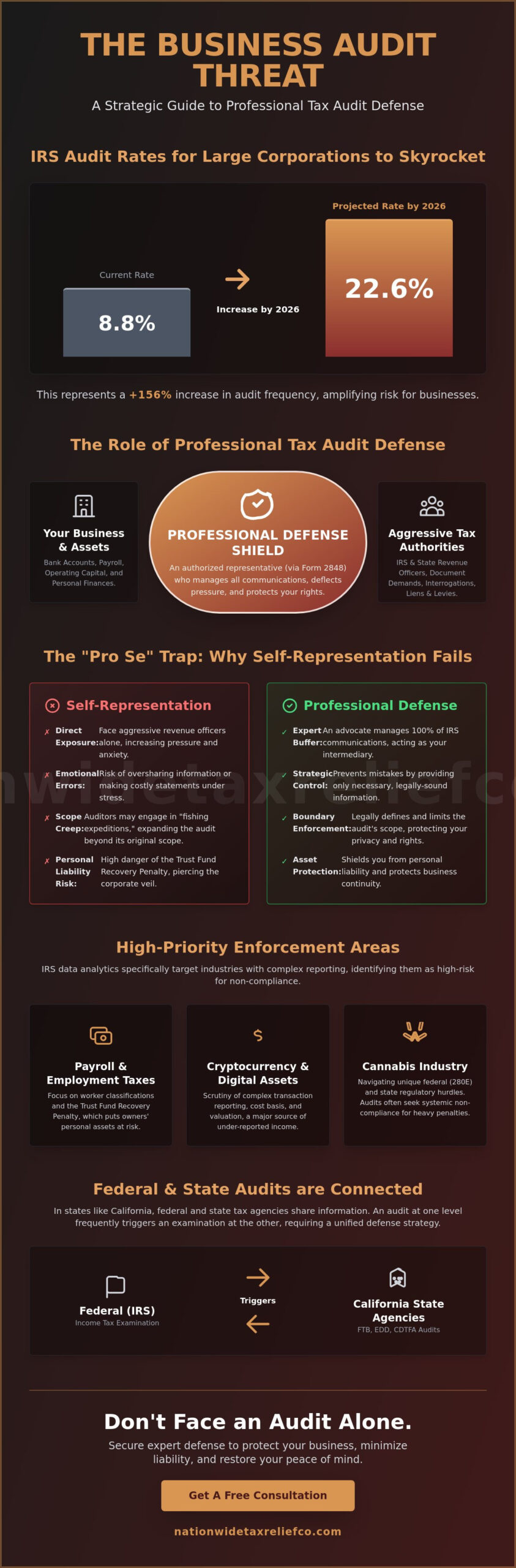
By 2026, the IRS expects to more than double the audit rate for large corporations, increasing the frequency of examinations from 8.8% to a staggering 22.6%. For any business owner, receiving a notice of examination feels like a direct threat to everything you’ve built. You might worry about aggressive revenue officers, the confusion of payroll tax regulations, or the sudden seizure of your operating capital.
It’s a high-stakes environment where a single misstep can lead to debilitating liens or even business closure. We understand that an audit is a crisis that requires a steady, expert hand to navigate. This article provides the roadmap you need to secure professional business tax audit defense, ensuring you can strategically minimize liabilities and protect your financial future. You’ll learn
how to resolve complex cryptocurrency and payroll tax issues, defend against administrative overreach, and move from a state of regulatory restriction to a position of financial freedom.
We’ll examine the specific steps to protect your bank accounts and remove existing levies so you can focus on running your company.
Key Takeaways
- Understand how professional business tax audit defense creates a strategic shield between your company assets and aggressive regulatory examinations.
- Identify the specific risks associated with high-priority enforcement areas like payroll taxes, cryptocurrency transactions, and the cannabis industry.
- Learn why representing yourself is a high-risk strategy and how professional advocates manage auditor interactions to protect your legal rights.
- Discover the essential steps to take within the first 48 hours of receiving a notice to ensure your documentation is technically sound and compliant.
- Gain insight into navigating the unique challenges of both federal IRS audits and California state agency reviews, including the FTB and EDD.
Table of Contents

- What is Business Tax Audit Defense and Why is it Critical?
- Strategic Defense for High-Risk Sectors: Payroll, Crypto, and Cannabis
- Professional Representation vs. Self-Defense: The “Pro Se” Trap
- The Business Audit Defense Process: From First Notice to Resolution
- Nationwide Tax Relief Co: Your Los Angeles Based Advocates
What is Business Tax Audit Defense and Why is it Critical?
Professional
tax audit representationis more than a simple administrative service; it’s a legal shield that redirects the focus of a government examination away from the business owner and toward a qualified advocate. At its core, business tax audit defense involves the formal appointment of an authorized representative to manage all communications, document requests, and technical arguments with the IRS or state authorities. This
intervention is designed to ensure that you aren’t forced to face aggressive revenue officers alone while trying to manage daily operations. The complexity of a business examination far exceeds that of a standard individual audit.
While a personal audit might focus on simple income verification, a business audit scrutinizes intricate operational systems. This includes analyzing your general ledger, verifying worker classifications, and auditing inter-company transfers. Because the IRS collected over $5.3 trillion in revenue during the 2025 fiscal year, their agents are highly incentivized to find discrepancies. The stakes are absolute. A poorly managed audit
doesn’t just result in a bill; it can freeze business credit, disrupt payroll continuity, and trigger personal liability for corporate debts. One of the most dangerous aspects of a business audit is the Trust Fund Recovery Penalty.
If the IRS determines that payroll taxes weren’t properly remitted, they can pierce the corporate veil and hold owners personally liable for the debt. This means your personal bank accounts and home could be at risk for a business-level failure. Securing a professional defense creates a clinical buffer that prevents emotional oversharing and ensures that the auditor stays within the legal boundaries of their request.
The Legal Authority of Representation
Securing business tax audit defense begins with the execution of Form 2848, the Power of Attorney. This document formally notifies the IRS that they’re legally prohibited from contacting you directly. It shifts the burden of communication to your defender, who understands the procedural nuances of an examination. IRS agents often prefer dealing with professionals because it streamlines the process and removes the emotional volatility that business owners naturally feel during a crisis.
Your representative defines the scope of the audit, ensuring the government doesn’t engage in a “fishing expedition” through records they don’t have the right to see.
Federal vs. State Audit Defense
In California, a unified defense strategy is mandatory because federal and state agencies share information through formal agreements. If the IRS discovers an error, they’ll notify California’s agencies, such as the Employment Development Department (EDD) or the California Department of Tax and Fee Administration (CDTFA). Conversely, a state-level sales tax audit often triggers a federal income tax examination. You don’t
just need a defender who understands the Internal Revenue Code; you need an advocate who can navigate the specific, often more aggressive, collection tactics used by California state investigators to protect your local operating permits and licenses.
Strategic Defense for High-Risk Sectors: Payroll, Crypto, and Cannabis
Certain industries operate under a permanent magnifying glass. While any company can be selected for an examination, the IRS has specifically identified payroll compliance, digital assets, and the cannabis industry as high-priority enforcement areas. For these sectors, a generic response to an inquiry is insufficient. You need a specialized business tax audit defense strategy that accounts for the unique regulatory hurdles and aggressive collection tactics used by both federal and state agencies.
Understanding why these areas are targeted is the first step in building a formidable shield around your company’s assets.The IRS uses sophisticated data analytics to identify returns that deviate from industry norms. According to official guidelines on
IRS Audits, the agency selects targets based on “discriminant function” scores and related examinations. In high-risk sectors, the goal of the auditor isn’t just to verify numbers; it’s to find systemic non-compliance that justifies heavy penalties. Specialized defense prevents the government from overstepping by ensuring that technical definitions are applied correctly and that your rights aren’t bypassed during the investigation.
Defending Payroll Tax Audits
Payroll taxes, specifically those reported on Forms 941 and 940, represent the most aggressive area of federal enforcement. The IRS views the “Trust Fund” portion of these taxes-the money withheld from employee paychecks-as funds held in trust for the government. If these aren’t paid, the agency doesn’t just fine the business; they often pursue the “responsible individuals” personally. In California, the Employment Development Department (EDD) is equally aggressive regarding worker classification.
A robust defense involves disputing reclassification attempts and demonstrating that your contractors meet the legal criteria for independence. If liabilities are confirmed, we focus on negotiating settlements that allow the business to maintain its daily operations without facing immediate bank levies.
Crypto and Cannabis Business Nuances
Cryptocurrency and cannabis firms face technical challenges that most tax professionals aren’t equipped to handle. In the digital asset space, the IRS focuses on unreported gains and complex basis tracking. Establishing a forensic basis in cryptocurrency audits requires a chronological reconstruction of every transaction hash to verify the exact cost basis and holding period for each digital asset. Without this
forensic level of detail, the IRS may default to a zero-basis assumption, which maximizes your tax bill. Cannabis businesses face the crushing weight of Internal Revenue Code Section 280E.
This regulation prohibits businesses “trafficking” in controlled substances from deducting standard business expenses like rent, utilities, or marketing. To survive an audit, your defense must focus on the meticulous allocation of costs to “Cost of Goods Sold” (COGS), which remains deductible. Implementing a strategic business tax audit defense ensures that these complex rules are used to your advantage rather than your detriment. If you are facing a high-stakes inquiry, securing
professional audit representationis the most effective way to protect your operating capital.
Professional Representation vs. Self-Defense: The “Pro Se” Trap
Entering a tax examination without a representative is a tactical error known as appearing “pro se.” This approach often leads to disastrous financial consequences because business owners underestimate the psychological expertise of government auditors. These agents don’t just look at numbers; they utilize specialized
Audit Technique Guidesto identify industry-specific vulnerabilities and elicit damaging admissions through casual conversation. While you might feel that explaining your business logic will lead to leniency, the auditor’s primary objective is to identify underpayments and assess penalties.The risk of “scope creep” is a constant threat when you defend yourself. A simple inquiry into a single tax year can quickly spiral into a multi-year probe if an auditor detects inconsistencies in your verbal responses.
Professional business tax audit defense provides a clinical barrier that prevents this expansion. We manage the “right to remain silent” in a civil context by ensuring that you aren’t placed in a position where you must answer open-ended questions that could be misinterpreted as evidence of negligence or fraud. Our role is to keep the examination focused strictly on the items identified in the initial notice.
Why Business Owners Should Never Speak to the IRS Directly
The concept of an “off-the-record” conversation doesn’t exist during an audit. Every comment you make is documented and can be used to establish intent. A professional representative acts as a technical filter, screening every Information Document Request (IDR) for legal relevance before any data is handed over. We specialize in narrowing the scope of these requests, ensuring the government doesn’t engage in a fishing expedition through your sensitive corporate records.
By removing the emotional element from the interaction, we ensure the audit remains a disciplined procedural matter rather than a personal interrogation.
The ROI of Professional Audit Defense
The financial return on a strategic business tax audit defense is often measured in the thousands of dollars saved through penalty abatement. Professional intervention frequently identifies procedural errors made by the auditor that can lead to a full reversal of proposed assessments. If you’ve already attempted to defend yourself and received an unfavorable ruling, we can initiate an Audit Reconsideration to challenge those findings with fresh evidence.
This process doesn’t just resolve the immediate debt; it protects your company’s long-term compliance status and prevents the administrative “red flags” that can trigger future investigations. Investing in an expert advocate is a methodical step toward ensuring that your business credit and operating capital remain intact.
The Business Audit Defense Process: From First Notice to Resolution
The first 48 hours after receiving an audit notice are the most critical for your company’s survival. Unlike “prepaid” defense plans that offer generic support, true emergency business tax audit defense requires an immediate, surgical analysis of the government’s claims. The process begins with a technical review of the Information Document Request (IDR), which is the primary tool auditors use to gather evidence. We don’t simply hand over files.
We scrutinize every request to ensure it’s legally relevant and within the scope of the examination.Before the auditor ever sees your records, we conduct a “Pre-Audit” simulation. This internal stress test allows us to identify potential weaknesses in your ledgers, such as undocumented expenses or worker classification inconsistencies. By finding these red flags first, we can prepare proactive technical explanations that neutralize the auditor’s concerns before they escalate into formal assessments.
This methodical preparation ensures that we’re never caught off guard during the negotiation phase; we rely on technical arguments and established precedents rather than hope.
Phase 1: Analysis and Power of Attorney
The immediate priority is to halt all direct contact between the government and your business. We achieve this by filing Form 2848, the Power of Attorney, which legally forces the IRS or state agency to deal exclusively with our advocates. This creates the necessary space to perform a comprehensive review of your previous tax filings and supporting ledgers. We look for technical discrepancies that might trigger “scope creep,” ensuring that a routine check doesn’t turn into a multi-year probe of your entire financial history.
This phase is about establishing a formidable perimeter around your sensitive corporate data.
Phase 2: The Examination and Technical Rebuttal
During the actual examination, we manage the “staging” of documents. This means we provide exactly what’s requested, nothing more and nothing less, in a highly organized format that leaves no room for ambiguity. If an auditor attempts to apply an unfavorable interpretation of tax law, we utilize established precedents and internal revenue manuals to challenge their position. Our objective is to drive the case toward a “No Change” letter or a resolution with minimal adjustments.
If you’re currently facing an active examination, you can
secure professional audit representationtoday to protect your operating capital and resolve the crisis with clinical efficiency.
Nationwide Tax Relief Co: Your Los Angeles Based Advocates
Navigating the intersection of federal and state tax enforcement requires more than just standard accounting; it demands a formidable advocate who understands the specific procedural nuances of both the IRS and California’s regulatory bodies. Nationwide Tax Relief Co provides specialized business tax audit defense that bridges the gap between complex federal requirements and localized state examinations. While our reach is
nationwide, our expertise is deeply rooted in the clinical efficiency required to protect business continuity and secure corporate assets against aggressive revenue officers. Our firm functions as a central hub of expertise, managing federal audits in all 50 states with the same level of meticulous attention to detail.
We recognize that an audit isn’t just a paperwork issue; it’s a threat to your company’s financial future. By positioning ourselves as a shield between our clients and governmental entities, we ensure that every interaction is handled with the discipline and compliance necessary to achieve a full resolution with minimal liability. Our steady hand in these high-stakes situations provides the calm and security you need to focus on your operations.
Localized Expertise in Tarzana and Los Angeles
For businesses operating in the Los Angeles area, local representation is a strategic necessity. Many national tax software companies or generic defense plans ignore state-level disputes, leaving owners vulnerable to the California Department of Tax and Fee Administration (CDTFA), the Franchise Tax Board (FTB), and the Employment Development Department (EDD). We specialize in managing these specific California agencies, ensuring that a state-level sales tax or payroll inquiry doesn’t dismantle your local operating permits.
If you’re facing a federal examination, our team provides the specialized
IRS Business Tax Auditdefense needed to navigate the system without compromising your personal or business bank accounts.
The Advantage of a Professional Resolution Firm
The complexity of modern financial regulation, particularly regarding cryptocurrency transactions and payroll tax settlements, requires a firm that has seen every possible scenario. We’ve successfully resolved intricate cases involving forensic accounting and worker reclassification, moving our clients from a state of restriction to a state of freedom. Our methodical approach ensures that every turn in the roadmap toward resolution is
accounted for. Waiting and seeing is the most dangerous strategy in a business audit because it allows the government to set the narrative and establish liabilities before you’ve mounted a defense.
We encourage you to seek a professional consultation immediately to secure your assets and restore your peace of mind.
Securing Your Company’s Financial Future
An audit notice is a serious regulatory challenge, but it doesn’t have to threaten your company’s survival. By implementing a strategic business tax audit defense, you transition from a state of uncertainty to a position of controlled resolution. We’ve examined how professional representation acts as a clinical barrier, preventing the “pro se” trap and ensuring that auditors stay within their
legal boundaries. Whether you’re navigating Section 280E for a cannabis firm or managing forensic basis tracking for cryptocurrency, the right advocate ensures your operating capital remains protected. Nationwide Tax Relief Co, based in Tarzana, provides the specialized expertise required to handle federal IRS examinations and local California disputes with the CDTFA, EDD, and FTB.
Our methodical approach is designed to safeguard your business continuity while resolving high-stakes liabilities across all 50 states. Don’t allow administrative overreach to dismantle your hard-earned success. Take the first step toward a definitive resolution today.
Secure Your Business with Professional Audit DefenseYou’ve built something valuable; let us provide the steady hand needed to defend it. With expert guidance, you can resolve your tax challenges and return your focus to what matters most: growing your business.
Frequently Asked Questions
What is the first thing I should do if my business receives an IRS audit notice?
The first step is to formally appoint a qualified representative by filing Form 2848, the Power of Attorney. This action legally halts all direct contact from the IRS or state agency, ensuring that you don’t inadvertently provide damaging information through casual conversation. Once representation is established, your advocate can begin a technical review of the notice to define the scope of the examination and protect your corporate records from unnecessary scrutiny.
Can the IRS seize my business bank account during an audit?
The IRS generally doesn’t seize assets during the examination phase itself; however, a bank levy can be issued if an audit results in an assessment that remains unpaid after the final notice. Effective business tax audit defense is designed to prevent this outcome by resolving the audit with minimal liability or establishing a formal resolution plan. Professional intervention ensures that administrative safeguards are in place to protect your operating capital while the case is pending.
How long does a typical business tax audit last with professional defense?
The duration of an examination depends on the complexity of the issues, but most business audits conclude within three to twelve months. Professional defense often streamlines this timeline by providing organized documentation and resolving technical disputes before they escalate into larger probes. By managing the Information Document Request (IDR) process efficiently, your representative prevents unnecessary delays and keeps the auditor focused on the specific items identified in the initial notice.
Does audit defense cover state agencies like the California EDD or CDTFA?
Yes, our firm provides comprehensive representation for California state agencies, including the Employment Development Department (EDD) and the California Department of Tax and Fee Administration (CDTFA). State audits are often more aggressive than federal examinations and require a deep understanding of local regulatory nuances. We coordinate a unified defense strategy to ensure that a state-level inquiry into sales tax or worker classification doesn’t trigger a secondary federal investigation.
What is a Trust Fund Recovery Penalty and can audit defense prevent it?
The Trust Fund Recovery Penalty is a personal assessment against individuals the IRS deems responsible for unpaid business payroll taxes. This penalty allows the government to pierce the corporate veil and seize personal assets, such as your home or personal bank accounts, to satisfy the debt. A robust business tax audit defense prevents this by challenging the “responsibility” and “willfulness” criteria required for the penalty or by negotiating a settlement that keeps the liability at the corporate level.
How much does professional business tax audit defense cost?
Fees for professional representation vary significantly based on the complexity of the case, the volume of corporate records involved, and the specific regulatory body conducting the audit. A simple correspondence audit requires fewer resources than a complex field examination involving multiple years of financial records. We recommend a professional consultation to evaluate the specific technical requirements of your case and provide a transparent overview of the defense process tailored to your situation.
Can I appeal the results of an audit if I already lost?
You have the legal right to appeal the findings of an audit through the IRS Office of Appeals or the U.S. Tax Court. If a previous self-defended audit resulted in an unfavorable assessment, we can also initiate an Audit Reconsideration to present fresh evidence or challenge procedural errors made by the auditor. This process allows for a methodical review of the government’s interpretation of tax law and provides a final opportunity to reduce your overall tax liability.
Will the IRS auditor come to my place of business?
While the IRS may request a “field audit” at your place of business, your representative can often move the examination to a professional office or handle it entirely through digital correspondence. This prevents the auditor from observing daily operations or interviewing employees, which can lead to “scope creep” and additional inquiries. Keeping the examination in a controlled, professional environment is a standard strategy to ensure the audit remains focused strictly on the requested documentation.
Building a Business Tax Audit Defense
A strong business tax audit defense starts with control of the records. When the IRS examines a company, an organized business tax audit defense presents clean books, worker-classification support, and documentation for every deduction, which keeps the examination narrow and factual.
Scope matters as much as substance. A disciplined business tax audit defense answers exactly what the auditor asks and no more, preventing a routine review from expanding into other years or issues. Where owner liability or payroll taxes are involved, a coordinated business tax audit defense also protects the individuals behind the company.





One Response